This begins a series of stories featuring families who choose different ways to educate their children, from charter to traditional to home and private schools. Contact us if you’d like to share your story.
Over the past five years, Leah Mong has navigated four children through a public academy school, two different private schools and a hybrid homeschooling program.
The often-used phrase “school choice” implies a one-time decision: a parent considers the schooling options for their child, picks one, and the student continues on that trajectory until graduation.
Mong’s journey illustrates a different type of school choice: One where parents constantly reassess what their child might need, and make changes when necessary.
“Not every school is the right fit for every child,” Mong explained. “Don’t feel like you’re stuck. I thought once I picked the school for my son, ‘we’re here till 12th grade,’ and, at first, I felt like such a failure when I wasn’t. But it was okay. We are growing, we are learning, we are adapting.”

Waiting on preschool
Mong started her parenting journey in 2013, with the birth of her oldest son. The family lived in Detroit at the time for her husband’s medical training, and Leah, who has a master’s degree in teaching, taught second grade for six years while they lived there.
When Jacob Mong’s medical training finished in 2014, the Mongs moved back to the Treasure Valley to be closer to family.
A few years after their move, Mong’s first schooling decision loomed before her: preschool for her oldest son.
At the same time, the Mongs had begun fostering two additional children, so as a stay-at-home mom Leah had three little kids to care for. The thought of adding preschool to their life was overwhelming.
“I loved a lot of preschool options, but finding the perfect fit for preschool and interviewing and all of that, it just felt easier to keep that time slower paced.”
That “slow pace” didn’t last long. In 2017, the Mongs adopted the two children they had been fostering. Then, just six weeks later, they were surprised to discover that despite previous struggles with infertility, they were pregnant with their fourth child.

Public and private kindergarten
After a whirlwind few years, the Mong’s commitment to finding the “right fit” for each child began, as their two oldest reached kindergarten age.
For one child, Mong felt The Ambrose School, a private christian school in Boise, would be the best fit. Recommended by friends, this school had a half-day kindergarten option. In 2024, nearly 90% of Idaho’s traditional school districts offered full-day kindergarten, making half-day kindergarten increasingly rare.
Since her oldest child had never been to school before, she liked the idea of “easing him into five days,” especially because, according to Mong, the school was “quite noted for its rigorous academics.”
For the other child starting kindergarten that year, Mong felt a public school called Galileo STEM Academy as part of the West Ada School District might be best. This child had some specific learning needs that had emerged early-on and Mong explained, “we knew [this child] would get lots of support, lots of paraeducators, lots of attention,” at the public school.
Mong emphasized her support for public education, noting that she has had other foster children who have also thrived in the public school system.
In the end, these two different schools worked well for her oldest children.
“We really loved both of our kids’ kindergarten experiences,” Mong said.

Private elementary school
In the Fall of 2020, the Mongs decided that their child who attended Galelio STEM Academy would benefit from another year of half-day kindergarten. This same child moved to Ambrose, and their oldest child started full-day first grade at Ambrose.
At the same time, their third child started in a new preschool that Ambrose had opened.
Total annual tuition for their three students would have cost about $14,000 (based on 2024-2025 school year pricing).
“For us, it does take a sacrifice,” she explained. However, Mong also noted, “I would have done anything possible to just make sure my kids were thriving. I’m not trying to get them to be the smartest in the class. I think it’s just important that they are well-rounded as a person, that they are kind, that they are confident in who they are, that they have quality relationships.”
The Mong family has paid for private school tuition without financial assistance.
However, Mong hopes initiatives like HB 93, the Idaho Parental Choice Tax Credit, will expand schooling options for other families who haven’t had the same flexibility.
“I hope that stipend could give parents that freedom to say ‘okay, I’ve been wanting to try this school; now it’s possible for us.’”
The highly debated HB 93 passed during the 2025 legislative session, and the $50 million program offers private schoolers and home-schoolers up to $5,000 for tuition and education expenses per student or $7,500 for special needs students.
Idaho has around 100 private schools, which enroll over 16,000 students, representing between 5% and 6% of school-aged children.
With all of their kids now in the same school, it would seem the Mongs could settle in.
“They all went to the same school that year, which was amazing. …We loved the theology and the feel of the school. We aligned with so many of their goals and values for their graduates that we thought, ‘we’re set.’”
But as Mong would learn, when customizing education for each child, things had to ebb and flow.
Private hybrid homeschool program
Despite the convenience of having all her kids in the same school, Mong saw that the rigor and pace of the school day were difficult for some of her children, “who were struggling as the intensity of the academics started to pick up.”
“The primary concern was the long days. There was also a massive homework load that was quite a big stress on our family.”
Mong realized things would need to change. Ambrose’s hybrid homeschool program, then about five years old, stuck out as a potential solution.
The idea of homeschool wasn’t actually new for the Mongs: parents Leah and Jacob had both been homeschooled.
“We had no reason why we wouldn’t do it with our kids, but we just thought, ‘No no, there’s so many good schools here.’ So we really were pretty firm.”
And yet, the “traditional” school week was just not working for some of her kids. She felt that given more time and a more flexible schedule, her kids with learning struggles could really succeed. And so, surprising both her and her husband, the family transitioned to a hybrid homeschool model.
This would mean two full days a week in Ambrose school where their kids had already been attending, and three full days at home where Leah would teach them. The school would provide curriculum and support, calling parents “co-teachers.”
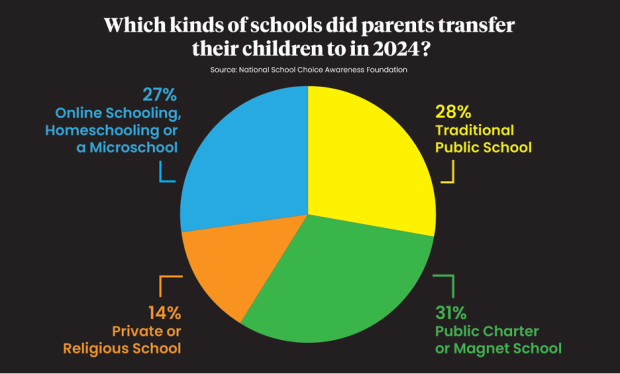
The Mongs are not alone in recently making a transition to a hybrid homeschool model. A 2025 EdChoice survey found that 60% of parents had considered changing schools last year (though only 28% made the change).
In the survey, of the parents who did transfer their kids, about 27% transitioned to some form of homeschooling.
Despite Mong’s strong feeling that this hybrid model would best address the needs of her kids, she still felt a little overwhelmed to get started.
“Although I was homeschooled, and although I taught (elementary for six years), homeschool is a whole other language in many ways — of curriculum, of organization, of culture.”
However, the overwhelm soon left. “It became quite apparent that with my background in education, it would not be hard for me to read a lesson plan and to figure it out. In fact, I kind of missed it a little bit.”
For most of her children, this hybrid model is working wonderfully. Mong loves how she can customize their schedule – prioritizing school work during the hours of the day when her children are most settled and productive. Plus, it lightens the homework load.
Mong emphasized her families shifting needs over time. When she had younger kids, she needed that time with them in school more to manage the day-to-day responsibilities of family life, and wasn’t ready to jump into homeschooling. However, as they got older, she had more capacity to “take stock on what’s working and what’s not working.”
The hybrid model also gives the Mongs the ability to pursue other passions. “Our time is going so fast, and there were so many other things we wanted to pursue and do with our kids: mountain biking, skiing.”
Mong’s advice for fellow homeschoolers: “Don’t invest in a Pinterest homeschool (set up)]. We tried that and they all ended up coming right to the kitchen table.”

Private hybrid homeschool And private full-time school
The story could end there, with the Mongs finding their “perfect fit” for schooling. But, despite the hybrid model working well for most of their children, the Mongs felt one child still needed something different. In the fall of 2023, they made the tough decision to have one of their children attend a new private school full-time.
“It was a very hard decision, because we were all doing (this hybrid homeschool model). And there was convenience to having the same school and schedule and everything. But I just had this epiphany of ‘why are we trying to make this happen so much?’”
They felt this private school would play to their child’s strengths, especially as they struggled with enjoying school. “We weren’t necessarily looking for another school. We were looking for something that could support existing talents and aspirations.”
And so, yet another schooling transition was underway. For now, this is working well. But Mong isn’t resistant to change in the future.
As their children grow, they will continue reevaluating their learning needs. Their “school choices” will ebb and flow with changes in their family.
The Mong family timeline
2013: First son born in Detroit, Michigan
2014: Move to Treasure Valley
2016/2017: Wait on preschool for oldest
2017: Adopt two children; pregnant with their fourth
2019: Oldest two children start kindergarten – one at a private school and the other at a public academy school
2020: Oldest three children at private school
2022: All four children transition to hybrid homeschoo/private school model
2023: Three children continue hybrid homeschool model, one child goes full-time at new private school