
MOSCOW — By all accounts, the 2025 legislative session was a doozy for education.
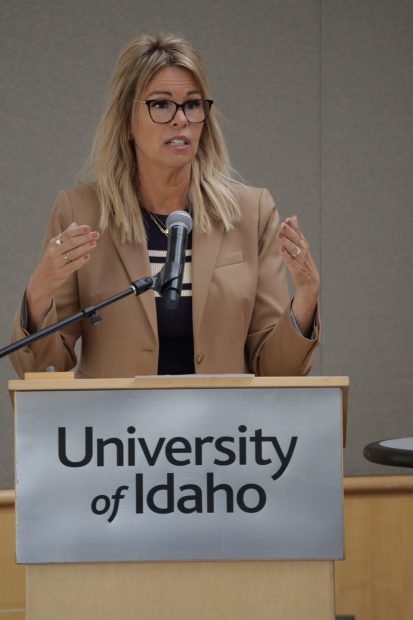
“Every legislative session has their own pace and their own feel, and this one is no different,” state superintendent Debbie Critchfield said Thursday, at the first stop of her post-legislative tour. “It felt like there was a lot of discussion, there was a lot going on.”
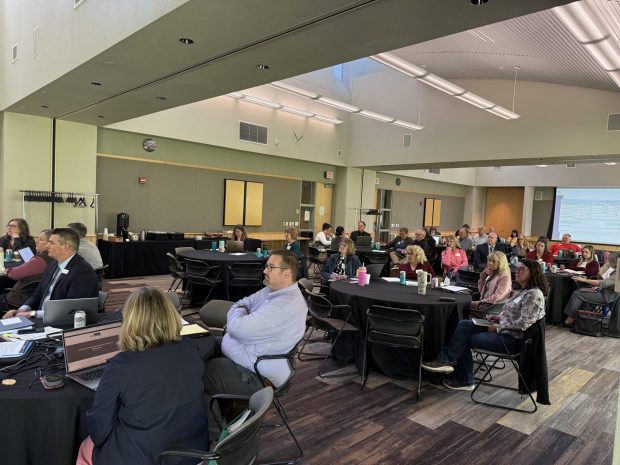
But it wasn’t the new laws impacting education that wove through every conversation at the University of Idaho, where school leaders gathered to hear Critchfield’s reflections and guidance on a session that will carry major implications for Idaho schools.
Instead, it was the misinformation and attacks on public education that permeated the discussion.
“There is a disconnect between what’s happening in our local districts and charters and some of the conversations that are taking place,” Critchfield said.
She encouraged educators to highlight the good work they are doing “so that that doesn’t get overshadowed by things that are maybe happening in other states or other national issues that really aren’t as prevalent in our classrooms.”
Each year following the legislative session, Critchfield travels to each of Idaho’s six regions to meet with school district leaders. She and her team explain what they need to do to comply with new laws, upcoming Idaho Department of Education initiatives and other issues that could impact schools.
Upcoming post-legislative session meetings:
- May 5 – Boise, BSU, Stueckle Sky Center, 1200 W. University Drive
- May 7 – Idaho Falls, ISU, Bennion Student Union, 1784 Science Center Drive
- May 8 – Pocatello, ISU, Pond Student Union, 1080 S. 5th Avenue
- May 9 – Twin Falls, CSI, Herrett Center, 315 Falls Avenue
The sessions run from 9 a.m. to 3 p.m.
More from EdNews: What passed? What didn’t? A detailed look back at the 2025 session
Promoting public education, correcting misinformation
As Critchfield opened the topic of promoting public education to district leaders in Moscow, Alicia Holthaus, superintendent in the Mountain View School District, was one of the first to speak up.
“What’s happening is there’s a public campaign to promote distrust in public education,” Holthaus said. “So you get a lot of rumors out there.”
She mentioned a popular conspiracy theory that schools are having children use litter boxes but there’s no evidence that’s happening and it would be illegal in Idaho.
“Those stories that just undermine the public’s faith, because then that faith translates to votes when the elections happen,” Holthaus said of calling out falsehoods. “So I don’t have an answer, but it sure would be amazing if you could call out the lies.”
Critchfield noted that of the 178 districts and charters in Idaho, only about 15 have a dedicated communications professional.
“Everyone else is like I don’t have time for that,” she said.
IDE plans to create a tool kit for school districts to promote the work they do and help them reach out to local media.
Also on Thursday, Critchfield and other IDE leaders noted multiple times that they had to do additional education and explanation to lawmakers this session than in previous sessions.
A prime example is the high-needs student fund, which set aside $3 million to help schools cover the costs for students with significant needs.
Critchfield hoped the funds would make a small dent in the $82 million gap between what Idaho schools are currently spending on special education and the funds they receive from the state and federal government.
The bill narrowly passed the House and the department thought they’d find support in the Senate but failed to do so. The senate narrowly rejected the bill.
Greg Wilson, Critchfield’s chief of staff, said that even small budget requests with significant evidence of need are requiring increased work to convince lawmakers to support.
“This was a very very big lift,” Wilson said.
Staff spent weeks playing “whack a mole” disproving claims that the fund would discriminate against certain students or would affect districts’ maintenance of effort.
“There was no shortage of things that were really kind of thrown at the wall,” Wilson said. “And we did our best to try and take care of those as quickly as possible.”
Critchfield attempted to address the frequent confusion over school funding both from legislators and community members with a new standardized financial reporting template.
“It’s so complex, many people tend to believe it’s being hidden or manipulated,” Critchfield said. “I think that this is the way for us to move forward on it.”
The form would satisfy state transparency posting requirements and would be auto filled out by the state based on school district’s audits and other documents districts already submit. Then local school boards and superintendents would affirm its accuracy.
The form simplifies where school districts get funds and how the funds are spent into a two page form.
Critchfield took feedback on the template. She quickly agreed to one superintendent’s suggestion to remove the requirement for a vice chair’s signature after a superintendent said that would add a logistical challenge.
“We’re intentionally talking about it and showing it around the state so we can get feedback,” Critchfield said.
Superintendents push back against alternative certification
Critchfield asked for feedback on her proposal for an alternative superintendent certification pathway that would remove education experience requirements.
Instead, candidates would need a bachelor’s degree and five years of relevant experience before entering a three year mentorship/coaching program.
She was met with near total opposition from the superintendents in attendance Thursday.
Shawn Tiegs from Moscow said he received his teaching degree through an alternative pathway but without classroom experience, he wouldn’t feel qualified to be a superintendent.
Holthaus agreed, arguing she has leadership experience but doesn’t think that qualifies her to lead a hospital.
Char Kremer, a Lewiston School Board member, also agreed that despite her extensive leadership experience and time on the school board, she wouldn’t be qualified to lead the district.
“No way would I ever consider myself superintendent material,” she said.
Critchfield said that she’s received questions on why people who qualify to lead a charter school, which has a different certification and requirements, couldn’t be the superintendent at a traditional public school. She also argued that local school boards have the final authority on who they hire to lead their district.
That led to Nez Perce superintendent Brian Lee bringing up, not by name, the situation in West Bonner County where Brandon Durst was hired to lead the district despite not meeting multiple certification requirements.
Lee said he worries that allowing alternative certifications could turn the position into a political appointment over a job that requires advanced educational leadership skills.
“If a board is in a spot where they want a political agenda pushed forward, potentially, and they have someone in the community who met those qualifications,” Lee said. “It could turn it into a political position, more than an educational position.”
Critchfield hopes to restart statewide professional development days
Idaho used to hold statewide professional development days for teachers but in the last decade, that practice has gone away. Critchfield hopes to bring it back.
She proposed doing the trainings regionally, which could reduce teacher isolation and build community, while reducing travel costs.
The practice could also help affirm statewide standards and best practices for things like classroom and behavior management, special education challenges, and artificial intelligence, she said.
Superintendents were supportive of the idea, suggesting that the state offer some of its mandated trainings as part of the PD days. Things like CPR, first aid, restraint and seclusion and dyslexia trainings are things that smaller districts often have to pay someone to come in and provide and having the state organize and cover the cost could be helpful, superintendents said.
Recordings of the trainings would also be helpful for mid-year hires, one superintendent said.

