Private schools in Idaho tend to serve more white students and have less racial diversity than their local public counterparts.
In some of the state’s largest private schools, those racial gaps widen significantly.
At the Sun Valley Community School, for example, 86% of students were white in the 2021-2022 school year — as compared to 54% in the local Blaine County School District.
There are similarly wide racial gaps in other large private schools, including three in the Treasure Valley: Cole Valley Christian Schools, Nampa Christian Schools, and the Foothills School of Arts and Sciences.
Those figures are according to a new database developed by ProPublica that aims to shine a light on demographics in private schools across the United States.
Read more about the database here, and explore it here.
The data has its limitations — it’s based on the Private School Universe Survey, a national dataset collected by the National Center for Education Statistics since 1989. Private schools are not compelled to participate, which has made the data spotty — some schools opt in some years but not others, or not at all. That means some of the data is missing or dated. Plus, since the information is reported by the school, there may be errors.
Still, it offers a window into the often-obscured world of private schools, which are not subject to the same transparency laws as public schools. And it comes at a time when public interest in private schools is growing as more states, like Idaho, embrace taxpayer-subsidized private schooling programs.
Racial gaps persist between Idaho’s private and public schools
There is no definitive list of private schools in Idaho, but the State Board of Education estimates there are about 112. Most are religious, and most are concentrated in the state’s urban centers.
And most, according to ProPublica, serve more white students than their local public schools.
Idaho private schools by the numbers
The State Board of Education released a report in January on school choice in Idaho. The figures below are from the report.
27: The number of private schools in Ada County (which has the highest count of private schools in the state).
21: The number of counties, out of 44, with no private schools.
18,000: The approximate number of Idaho students attending private schools.
313,000: The approximate number of Idaho students attending public schools.
In Idaho, nearly 82% of students at private schools are white, as compared to 74% in public schools — or a racial difference of 8%. That’s according to the most recent data, from the 2021-2022 school year.
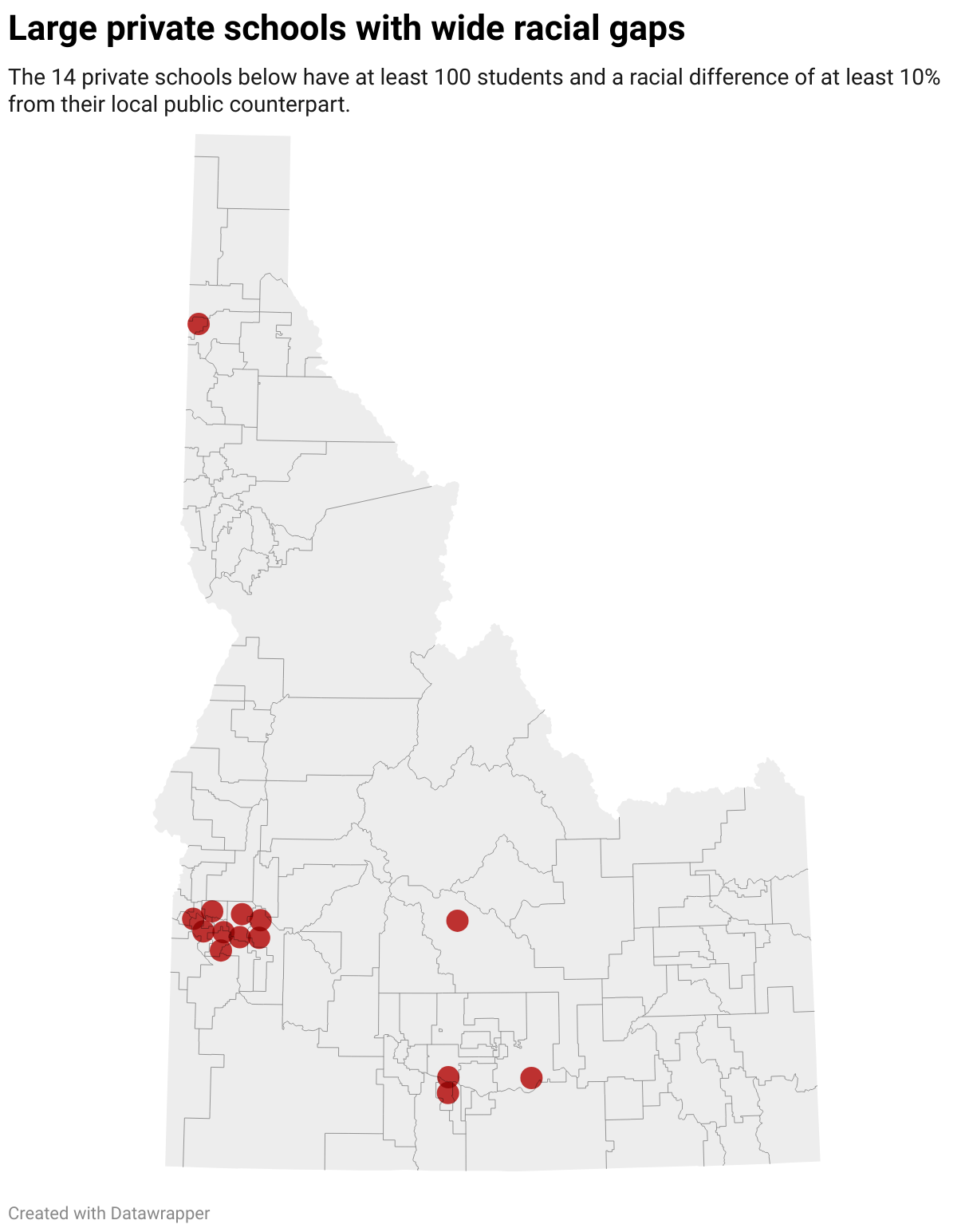
And in 14 of the state’s largest private schools — with an enrollment of 100 or more — the racial difference when compared to their local district is 10% or higher.
Those schools and their approximate location are shown on the map below. Click or hover on each dot for more information.
EdNews reached out to four large private schools with the highest racial disparities: Sun Valley Community School, Nampa Christian Schools, Cole Valley Christian Schools and Foothills School of Arts & Sciences.
Representatives from Sun Valley Community School and Nampa Christian Schools did not respond to multiple interview requests.
Nick Cofod, Foothills’ head of school, said diversity is important to the school and its families. The school’s latest data available on the ProPublica database was from the 2017-2018 school year, and showed a racial difference of more than 20% from the local Boise School District.
Cofod shared updated demographic information from this school year with EdNews. But the new numbers showed that the racial gap between Foothills and Boise School District has stayed about the same over time.

Foothills’ website includes a page on diversity, equity and inclusion efforts, including striving to “recruit, enroll/hire, and retain as diverse a population as is feasible in the community.”
Cofod said the school also has diverse representation in its curriculum. And he pointed out that approximately 20% of Foothills’ students receive financial assistance.
That’s still a smaller percentage of students from low-income families than at the Boise School District, where 36% of students qualify for free or reduced-price lunch.
When asked if students are ever turned away from Foothills due to factors like ability or disability level, behavior, or grades, Cofod said he would get back to EdNews with an answer, but did not.
Allen Howlett, superintendent of Cole Valley Christian Schools, said they do not track students’ demographics.
Yet ProPublica’s database indicates that Cole Valley’s secondary school had a racial difference of somewhere between 14% and 24%, according to data Cole Valley submitted in 2021-2022. But since Cole Valley doesn’t track that information, Howlett says he has “no idea” how ProPublica got the information, but acknowledged they may have opted into the survey at that time.

Specific numbers aside, Howlett said Cole Valley schools likely do have more white students and less racial diversity than area school districts because Idaho’s non-denominational Christian populations tend to be more white as well.
“If you walk into one of our classrooms, I think you’d find we’re very representative of most of the Christian churches you would walk into,” he said.
Cole Valley considers factors like religion, ability or disability level and behavior when deciding whether to admit a student, Howlett said, and may turn away students based on one or more of those factors.
Cole Valley does have students with disabilities and a special education program. But if the schools did not have adequate services to support a student with special needs, it might deny that student, Howlett said. Students with disabilities are charged an additional cost for those services.
In terms of religion, at least one of the students’ parents must be a “Bible-believing Christian,” Howlett said.
At private schools with big racial gaps, the cost of education is at a premium
At the four large private schools with the most notable racial gaps, tuition is between $5,700 and more than $40,000 per year. Idaho’s just-passed private school tax credit program offers qualifying private schoolers up to $5,000 — or $7,500 for special needs students — for tuition and other expenses.
Eight private school leaders, including Howlett, recently wrote in an open letter to Gov. Brad Little that House Bill 93 would “increase access to private school education” and be “life-changing” for private school leaders and students.
But even with the help of a tax credit, education at some private institutions could remain out of reach for families unable to pay the difference.
| School | 2025-2026 Tuition Cost (kindergarten level on) | School-provided financial aid |
| Sun Valley Community School | $20,000 to $41,200 | Yes, unclear how much |
| Cole Valley Christian Schools | $7,550 to $10,660 | Yes, up to 50% for qualifying families |
| Nampa Christian Schools | $5,700 to $9,300 | Yes, up to 30% for qualifying families |
| Foothills School of Arts and Sciences | $17,997 to $18,766 | Yes, unclear how much |
Howlett said Cole Valley does not track the socioeconomic status of its students, partly because the schools’ families tend to value their privacy. But he said students from lower-income households are less likely to enroll at Cole Valley.
“I mean, how many (low-socioeconomic) families … are going to be able to afford a $10,000 a year tuition?” he said.
Howlett said he hopes the tax credit law will help some of those families, and said a number of families have had to withdraw from Cole Valley within the past few years because of financial issues. A tax credit would have a “significant impact” on them, but even with a tax credit, most families would still have to pay remaining tuition out of pocket.
Idaho’s tax credit law gives priority to applicants with household incomes 300% or below the federal poverty limit, but does not have any stipulations regarding non-discrimination policies. Sen. Dave Lent, R-Idaho Falls, sponsored a private school choice bill that would have required private schools to adopt non-discrimination policies based on race, religion and disability in order for their tuition to qualify as an eligible expense. However, his bill was defeated by the Senate on a 6-28 vote.
Related reading: Low-income students, religious schools, urban areas: Who will benefit from a school choice program?
Idaho Education News data analyst Randy Schrader contributed to this report.