
A bill to cut income taxes by $253 million is heading to Gov. Brad Little’s desk.
The Senate overwhelmingly supported House Bill 40 Tuesday, solidifying a veto-proof, two-thirds majority in both chambers.
HB 40 would reduce the individual and corporate income tax rate from 5.695% to 5.3%. It would also expand an income tax exemption for military pensions and eliminate capital gains taxes on gold and silver bullion.
Sen. Doug Ricks, the Senate sponsor of HB 40, said the bill would allow taxpayers to decide how their money is spent. “When dollars change over and over, it really spurs on and stimulates the economy,” said Ricks, R-Rexburg.
It’s unclear whether Little will sign HB 40. The Republican governor earmarked $100 million for tax cuts at the beginning of the session. But legislative leaders have proposed more than $450 million altogether.
“If I thought we could have done $450 million I would have proposed $450 million,” Little told reporters last week.
Still on the table are House Bill 304, which would direct $100 million to property tax relief, and House Bill 231, which would increase credits for sales tax on food by $50 million.
During Tuesday’s debate, Democrats said the income tax cut would be fiscally irresponsible. Idaho is losing employees over pay and struggling to recruit and retain judges, said Senate Assistant Minority Leader James Ruchti, and public schools need more money to address aging facilities.

“The list goes on and on,” said Ruchti, D-Pocatello. “It’s not that we don’t have the money to take care of our state’s needs. It’s that we’re not willing to forgo another tax cut bill to pay these bills.”
Only two Republicans — Sens. Jim Guthrie, R-McCammon, and Jim Woodward, R-Sagle — joined the six Senate Democrats in opposition. Guthrie argued the state should hold off on cutting taxes amid economic uncertainty tied to President Donald Trump’s “aggressive posturing” on fiscal policy, which has included cutting federal employees and programs along with imposing tariffs on Canadian, Chinese and Mexican imports.
“We are in some unique times that carry with them some incredible unknowns,” Guthrie said. “We must think beyond today.”
Sen. Joshua Kohl, R-Twin Falls, who also supported the bill, said if there are “hard economic times coming for the people of Idaho, the best thing this body can do is cut as many taxes and fees for them as possible.”
Two Joint Finance-Appropriations Committee members — Sens. Janie Ward-Engelking, D-Boise, and Kevin Cook, R-Idaho Falls — objected to passing a tax cut without first setting a revenue projection for next fiscal year. JFAC revenue-setting stalled in recent weeks after split votes between House and Senate members.
“Revenue has become an afterthought, kind of like it’s a thorn in our side,” said Cook, who ultimately voted in favor of HB 40. “We’ve adopted the mindset that we’ll set the revenue once we understand how much money we want to spend.”
Sen. C. Scott Grow, co-chair of the budget committee, said JFAC plans to vote on a revenue projection Wednesday. In the meantime, lawmakers can only guess at how much money the state will bring in while continuing to be “conservative with our citizens’ taxes.”

“There are booms and there are recessions,” said Grow, R-Eagle, who supported the bill. “We have to do what we think is best, based on our current knowledge of what’s happening.”
The Division of Financial Management Monday released preliminary revenue projections for February, which showed that state revenue came up short of projections for the second consecutive month. Year-to-date tax collections are about $57 million behind projections, the analysis shows.
House unanimously approves $100 million in property tax relief
The House endorsed another $100 million in tax relief Tuesday, shortly after the Senate approved the income tax cut.
House Bill 304 would send school districts $50 million annually to pay down bonds and levies through a mechanism established by a 2023 property tax relief law. Another $50 million would go directly to property taxpayers.
The House unanimously approved the bill Tuesday, although a couple lawmakers expressed concerns similar to those raised during the Senate’s income tax cut debate.
“I’m all about reducing taxes,” said Rep. Stephanie Mickelsen, R-Idaho Falls, who voted in favor of the bill. “…But at the same time, I think we’re in a situation that we would be a little bit foolish not to look at what’s going on in the economy around us.”
House Majority Leader Jason Monks, a Republican from Meridian and co-sponsor of HB 304, acknowledged that state revenue could decline in the future — or it could increase.
“A lot of things can happen in our economy,” he said. “But I’ll ask you this question, ‘Who would you rather have holding the money, our citizens and our constituents or the state government?'”
HB 304 now heads to the Senate.
House passes school administrator ‘apprentice’ bill
A divided House passed a bill to allow rural schools to hire school administrators through an “apprenticeship” program.
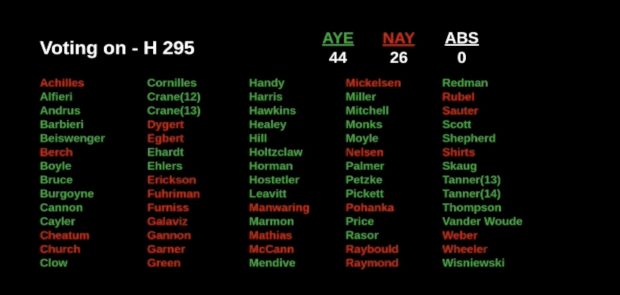
House Bill 295 would open principals’ and superintendents’ jobs to applicants with a bachelor’s degree and “a professional background that demonstrates competency” in education, the public or private sector, the military or nonprofits. A district would need to agree to sponsor the apprentice.
“This gives small communities an option that they do not have today,” said Rep. Dale Hawkins, R-Fernwood, the bill’s sponsor.
Two opponents stopped short of mentioning Branden Durst by name — but they clearly referred to the former legislator’s brief and turbulent tenure as superintendent of the West Bonner School District. When trustees hired Durst in 2023, he did not meet the State Board of Education’s five criteria for a superintendent’s endorsement. Durst submitted a resignation letter after the State Board denied him emergency certification; Durst has since sued the district.
“We don’t need more problems, with people who do not hold a proper certificate,” said Rep. Lori McCann, R-Lewiston.
Calling the Durst hire “a cautionary tale,” Rep. Mark Sauter, R-Sandpoint, urged bill supporters to come up with better language that would serve schools and applicants.
Speaking in favor of the bill, Rep. Chris Bruce said the sponsorship requirement provides a backstop. “Nobody’s going to walk off the street and get approved by the district,” said Bruce, R-Kuna.
HB 295 passed, 44-26, and goes to the Senate.
Special education funding proposal heads to House
After school officials outlined the high costs of special education programs, a House committee endorsed a new program designed to offset some of the costs.
House Bill 291 would create a “high-needs student fund,” a state fund to address local special education needs. State superintendent Debbie Critchfield is requesting $3 million for the program.
“We expect that the $3 million will go very quickly,” said Chynna Hirasaki, the Idaho Department of Education’s special education director.
The money could go quickly, because large and small districts often incur high special education costs.
The Twin Falls School District spent more than $117,000 to add two full-time educational interpreters for deaf students, special education director Kindel Mason told the committee. The job is taxing and physically demanding, and schools should hire two interpreters for every student who needs the support.
In Southeast Idaho’s West Side School District, the cost of a one-on-one American Sign Language interpreter came in at just over $30,000. Special education director Ramona Lee said her district got off light; an interpreter could easily have cost twice as much, she said.
Idaho has more than 40,000 special needs students, Hirasaki said. That number grew by more than 1,000 students from 2023 to 2024.
HB 291 would create a state-local partnership.
The local school would still be responsible for the first $15,000 of its high-demand student costs. The state would pick up the next $65,000, and, after that, 80% of any additional costs.
Ultimately, the state’s responsibility maxes out at $100,000 per student.
Rep. Dale Hawkins, R-Fernwood, noted that 30 student cases could swallow up the entire $3 million fund. “I’m just wondering where we go with this.”
The bill’s sponsor, Rep. Ben Fuhriman, R-Shelley, acknowledged the scope of the need, and the $80 million special education funding gap that local schools have to fill. “There’s way more needs … but this is a good first step.”
House Education sent HB 291 to the House floor on an 11-3 vote, over objections from Hawkins and Reps. Kyle Harris, R-Lewiston, and Kent Marmon, R-Caldwell.
HB 291 would establish the high-demand student program, but it wouldn’t fund it. The Legislature would have to bankroll the program with a separate budget bill.
Budget-writers ask Critchfield about transportation software, IRI, federal funding
Most of state superintendent Debbie Critchfield’s budget priorities will need approval from policy committees before they reach the Joint Finance-Appropriations Committee. But that didn’t stop her from making an early case to budget-writers Tuesday.
Critchfield is pushing for a number of public school funding changes, including implementing a weighted formula and outcomes-based component along with the new special needs funding that the House Education Committee advanced Tuesday.
JFAC would be responsible for spending bills if the policy changes become law.
“We truly are serving the state, and we’re serving the families, and we’re working hard in our communities,” Critchfield told JFAC. “Our recommendation is a result of talking with our district leaders, looking to see where those gaps are, trying to have an approach that takes in the realities of where we are, of the modern classroom.”
JFAC already approved a $3.28 billion base budget for public schools, which is awaiting a vote by the full House. Tuesday’s hearing focused on “enhancements” to this budget, including $25.3 million for the weighted formula and $3 million for special needs funding.
Budget-writers didn’t make a decision on the enhancements Tuesday, but they asked about:

Transportation routing software
Critchfield asked for $5 million to implement a statewide transportation routing software that school districts could use to manage busing.
Rep. James Petzke, R-Meridian, asked Critchfield to follow up with data on how many districts would use the software. Gideon Tolman, chief financial officer for the Department of Education, didn’t share specific numbers but said many districts don’t have their own software.
“Particularly for our smaller rural districts and charters, it’s cost prohibitive for them to to get the type of routing software that would be most beneficial to them,” Tolman said.
IRI vendor
Petzke also asked Critchfield to justify an additional $625,800 for the state’s standardized reading assessment, the Idaho Reading Indicator. The base budget already includes $532,000 for the IRI, Petzke noted.
The Department of Education last month announced that it had renewed its IRI vendor contract with Amira Learning, formerly known as Istation. Tolman said the additional funds would improve the assessment itself and the data it produces.
“It’s taking what was an assessment at one level to a better level, to provide better data and a better assessment for the state.”
Expired COVID-19 funds
Sen. C. Scott Grow, co-chair of the budget committee, asked Critchfield to weigh in on how districts spent federal COVID-19 aid, which has since expired.
“One of the concerns we had, as you recall, with all this federal money coming in, is that it would be used in such a way that districts would become dependent upon it, and then when it went away, they would expect the state to fill the hole,” said Grow, R-Eagle.
Critchfield said about 80% of school districts used the federal dollars for ongoing expenses such as teacher salaries. In 2023, Critchfield sent a letter to administrators warning that the money would stop and suggesting that they phase it out of their ongoing budgets, she said.
Critchfield also said that she declined an offer from the U.S. Department of Education to extend the pandemic aid period. But there were “big payoffs” to the federal funds, Critchfield said, including investments in learning and teacher training.
U.S. Department of Education
Sen. Jim Woodward asked about Critchfield’s meeting last week with U.S. education secretary Linda McMahon, who was confirmed by the U.S. Senate Monday.
Trump has vowed to dismantle the U.S. Department of Education, an idea that Critchfield has said she supports. Woodward, R-Sagle, asked how the move would affect states that receive federal education funding and the regulation that comes with it.
“Simply put, the conversation to me was ‘We want the states to have the money, but we don’t want them to have the bureaucracy at the federal level,’” Critchfield said. ”That was something that I was hoping to hear. And we certainly don’t want to be in a position where we have 100% of the rules and 20% of the money.”
House passes campus free speech bill
After brief debate — and over a scattering of bipartisan opposition — the House passed a campus free speech bill.
“Let’s not look for reasons to shut down our First Amendment,” said Rep. Barbara Ehardt, R-Idaho Falls, the sponsor of House Bill 240.
The bill would ban colleges and universities from restricting “the protected expressive activity of any member of the campus community.” Colleges and universities would be required to establish policies “prohibiting student-on-student harassment,” and face penalties of up to $25,000 for violations.
Opponents raised a variety of concerns with the bill.
Rep. Mark Sauter, R-Sandpoint, said he was worried about expecting state courts to settle civil claims — and wading into First Amendment disputes that belong in the federal courts.
Rep. Steve Berch, D-Boise, objected to wording that could protect radical student groups on either end of the spectrum. The bill covers recognized student groups, or groups “seeking official recognition.”
With the House’s 55-15 vote, HB 240 now heads to the Senate.
Senate lightning round: community college tuition, higher ed contracts
Working late into the afternoon, the Senate sent two education-related bills to Gov. Brad Little.
Community college tuition. House Bill 79 would raise the cap for community college tuition for the first time since 2008. The cap would increase from $2,500 per year to $3,250. The colleges could increase their tuition by 10% per year, but bill sponsors say they expect the four two-year schools to seek increases of about 5%.
This bill passed, 26-9.
Higher education contracts. House Bill 34 would allow state agencies to contract directly with Idaho’s colleges and universities. Supporters say the bill would allow higher education institutions to more easily compete for agency contracts. The bill passed, 34-0.

