It might be easier to name the people who don’t have stake in House Bill 93.
The controversial legislation that created Idaho’s new Parental Choice Tax Credit is the subject of an ongoing lawsuit. And educators, parents, politicians, attorneys and advocates have lined up on both sides, making their case to the Idaho Supreme Court about whether the state should be allowed to subsidize private education.
Created by Republican policymakers through HB 93 this year, the tax credit offers Idaho students up to $5,000 — or $7,500 for students with disabilities — to offset private school tuition, home-school supplies and other nonpublic school expenses.
In September, a coalition of opponents sued to block the new program from taking effect. State attorneys are defending it, backed by supporters from Idaho to Arkansas to Indiana.
Here’s how the two sides stack up:

The plaintiffs
The coalition that sued to block HB 93 includes nine plaintiffs: two advocacy groups, a teachers’ union, a school district and five individuals, including a former state superintendent and current state lawmaker. Each filed declarations with the Idaho Supreme Court explaining their opposition to the tax credit.
The coalition — through attorneys at Hawley Troxell, a Boise-based law firm — asked the Idaho Supreme Court to declare the Parental Choice Tax Credit unconstitutional and block the state from implementing it. The argument largely focuses on the Idaho Constitution’s education “uniformity” clause, which says the Idaho Legislature has a duty “to establish and maintain a general, uniform and thorough system of public, free common schools.”
The Parental Choice Tax Credit, meanwhile, funds a separate education system that’s private, tuition-based and not open to all students.
“Plainly, the Idaho Constitution states that the Legislature’s duty (is) to establish and maintain one system of public education that is general, uniform, thorough, public, free and common,” attorneys for the coalition wrote in a September petition. “By its very language, the Legislature may not establish and maintain other educational systems outside of this single system.”
The coalition includes:
Committee to Protect and Preserve the Idaho Constitution
This advocacy group, composed of lawyers, says its mission is to “safeguard the Idaho Constitution from legislative overreach.” In 2021, the group, together with Reclaim Idaho, successfully sued the state to overturn a law that made it harder to qualify ballot initiatives.
Daniel Mooney, a Boise attorney and president of the committee, wrote in a declaration to the court that he has a “personal stake in the quality and constitutional integrity” of Idaho’s public schools, since he has one child enrolled in public school and another who will enroll in the future.
“In this case, the Committee again seeks to protect and preserve the Idaho Constitution as a private attorney general where the State’s elected Attorney General will not,” Mooney wrote.

Mormon Women for Ethical Government
A national nonprofit based in Utah, MWEG includes hundreds of Idaho women who hold views “across the political spectrum,” according to a court declaration from state director Cindy Wilson. The group “promotes ethical governance through advocacy and civic empowerment” and supports the separation of church and state.
“By authorizing and allocating taxpayer funds in the form of voucher subsidies for parents to use to pay for tuition and expenses at non-public schools, HB 93 is effectively creating and funding a separate system of eligible private schools in violation of the Idaho Constitution,” Wilson wrote.
Wilson is a Boise educator who ran for Idaho state superintendent as a Democrat in 2018, losing to Republican Sherri Ybarra. She also served on the Idaho Governor’s Education Reform Task Force.
Moscow School District
This public school district serves a “diverse” population — including students from urban and rural backgrounds along with students with disabilities — in an area that also hosts “significant” nonpublic schooling options, superintendent Shawn Tiegs wrote to the court.
But private schools, learning pods and home-school options tend to draw from “homogenous populations” relative to public schools, Tiegs wrote, and they can exclude students based on religion, disability or other factors.
“This lack of representation and inclusivity shows that private schools within our district will not provide an equitable alternative to all students in our district and will only exacerbate discrimination and educational inequality in the region,” Tiegs wrote in a court declaration.
Idaho Education Association
The statewide teachers’ union has long opposed subsidies for private education, and in recent election years backed opponents to lawmakers who support private school choice.
IEA Executive Director Paul Stark told the court that public schools “already face significant resource constraints,” and HB 93 “undermines” educators’ goals to maintain funding and ensure equitable access for students.
“The absence of transparency and public oversight risks deepening inequities and eroding Idaho citizens’ ability to ensure that their tax dollars advance a public purpose,” Stark wrote.
Jerry Evans
Jerry Evans was Idaho’s Republican state superintendent from 1979 to 1995.
He wrote in a court declaration that the Idaho Constitution mandates a “single public school system” that’s “available to all children” and administered by the Idaho State Board of Education and state superintendent — not the State Tax Commission.

“By placing the administration of the tax credit program with the State Tax Commission, the Legislature has misallocated the authority to an improper and inexperienced group, which weakens public education, undermines constitutional mandates, and threatens the fair and thorough schooling Idaho children deserve,” Evans wrote.
Marta Hernandez
A teacher in the Cassia County School District, Marta Hernandez told the court that HB 93 will “disproportionately” harm rural public school students by siphoning state funds.
“This diversion threatens the financial resources of public schools like mine, making it increasingly difficult to retain qualified teachers, maintain reasonable class sizes, and offer comprehensive educational programs,” Hernandez wrote in a court declaration.
Stephanie Mickelsen
Rep. Stephanie Mickelsen, a Republican from Idaho Falls, joined the lawsuit after opposing HB 93 during this year’s legislative session. She told the court that she has 18 grandchildren, including 12 who attend public schools.
“I voted against the education tax credit legislation, HB 93, because the bill does not adequately support the school districts and my constituents within my district,” Mickelsen wrote. “Another reason I voted against HB 93 is because I strongly believe that religious teaching of any faith should not be financed or subsidized with public money.”
Alexis Morgan
Alexis Morgan is an Eagle mother of four, including two children in public schools. She previously served as president of the Idaho Parent Teacher Association. Now Idaho PTA’s director of public policy, Morgan told the court that she advocates for equity and religious freedom in education.
In 2020, she applied to a private school on behalf of her daughter, Morgan wrote in a court declaration. During a tour with administrators, Morgan learned that she’s a “particular ‘brand’ of Christian” that’s disparaged in the school’s middle-school curriculum. The school — which Morgan did not name in the declaration — later denied her daughter’s application, she told the court.
“My daughter’s story, along with many others, has fueled my commitment to advocate for religious tolerance and educational access across Idaho,” she wrote.
Kristine Anderson
Kristine Anderson is a Rexburg mother of four children, three of whom attend the Madison School District. Two of the children are enrolled in an Individualized Education Program (IEP) for speech-related disabilities.
Private schools “typically do not accept children” with speech-disabilities, Anderson wrote in a court declaration, and even when they do, “essential therapies, resources, and legal safeguards are unavailable.”
“For my son, his IEP represents not only a customized education plan but also the only structured and enforceable pathway to progress, inclusion, and safety within the school environment,” Anderson wrote.
Supporters of the plaintiffs
Eight other people filed court declarations in support of the plaintiffs’ challenge to HB 93, including:
- Karli Hosman and McKenzie McFarland — Members of the Church of Jesus Christ of Latter-day Saints who said their children were denied entry to religious schools because of their faith,
- Susan Peterson and Kathleen Ross — Mothers from Ada County who said their children with disabilities rely on public school services,
- Linda Patchin — Chairwoman of Homeschool Idaho, a nonprofit advocacy group that opposed HB 93,
- Brady Dickinson — Superintendent of the Twin Falls School District,
- Shane Williams — Superintendent of the West Jefferson School District, and
- Kevin Ramsey — A public school educator in the South Lemhi School District.
The defendants
The coalition sued the Idaho State Tax Commission, the agency responsible for administering the Parental Choice Tax Credit. But the Idaho Legislature, which enacted the new program, also intervened to defend it.
In addition, individuals and advocacy groups from Idaho and beyond have filed arguments urging the Supreme Court to uphold the tax credit.
Attorneys defending the program have argued that the Idaho Constitution’s mandate for a “uniform” school system sets a floor but not a ceiling. The overarching goal of the constitution’s education provisions is facilitating an “educated citizenry,” which can also be accomplished in nonpublic schools, wrote private attorneys hired by the Legislature.
“So long as the Legislature creates and maintains the system of uniform public schools, it is not forbidden from facilitating other educational opportunities,” the Legislature’s attorneys wrote in a brief filed last week.
The defendants include:
Idaho Legislature
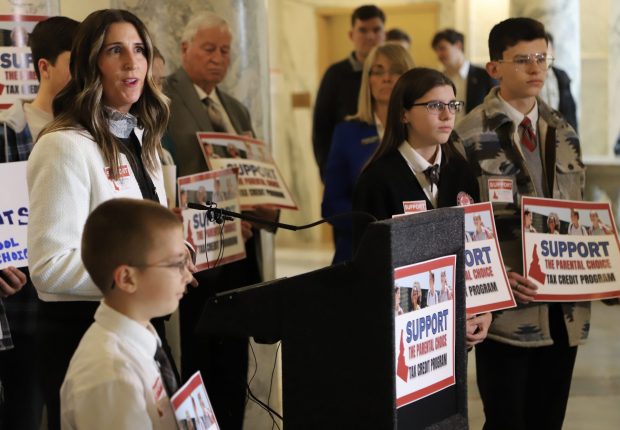
When the Idaho Legislature passed HB 93 in February, and Gov. Brad Little signed it into law, it was a landmark moment for supporters of private school choice.
Advocates for years had pushed the Legislature to enact a program helping Idaho students pay for private-school and home-school expenses. After the Idaho Senate narrowly approved the bill on Feb. 18, co-sponsor Rep. Wendy Horman shed joyful tears outside the Senate chamber as she celebrated with Kate Haas, a lobbyist for yes. every kid., which had spent hundreds of thousands of dollars on school choice advocacy in Idaho.

“The reason I ran for elected office in the first place was because I care about the education of every child, no exceptions,” Horman said when introducing the bill earlier this year. “School choice policies provide families with new opportunities, while taking no existing opportunities away from other children.”
President Donald Trump also endorsed the bill, writing on social media in February that it would empower “parents to provide the very best Education for their child.”
Support in Idaho was far from unanimous, however. Sixty-two state lawmakers voted in favor of the bill while 43 opposed it — 28 Republicans and 15 Democrats. And public comments to the Legislature overwhelmingly opposed it.
But HB 93’s passage finally counted Idaho among the growing number of states subsidizing private education. Thirty states, plus Washington, D.C., had private school choice programs as of September, according to an analysis by Education Week.
Shortly after the coalition filed its lawsuit challenging Idaho’s new program, legislative leaders intervened to defend it alongside the attorney general’s office. They hired private attorneys from Givens Pursley, a Boise law firm.
“I wish we didn’t have to go through a lawsuit on this, but hopefully we can get it resolved soon and move on,” House Speaker Mike Moyle, R-Star, said at the time.

HB 93 was co-sponsored by:
- Horman, R-Idaho Falls,
- Senate Majority Leader Lori Den Hartog, R-Meridian,
- House Majority Leader Jason Monks, R-Meridian, and
- Sen. C. Scott Grow, R-Eagle.
Idaho State Tax Commission
The agency charged with administering the tax credit is busy setting it up before applications are scheduled to open Jan. 15. In the meantime, the attorney general’s office is defending the program in court.
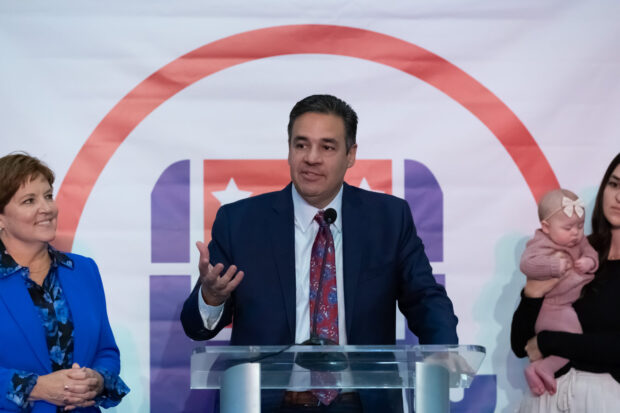
Attorney General Raúl Labrador laid the groundwork for this defense long before a lawsuit was filed. On Feb. 28, the day after the governor signed HB 93 into law, the Republican published a letter defending its constitutionality.
“As with most all legislation, it’s not perfect, but it’s a good start for something that plays an outsized role in our state – meeting the educational needs of our kids,” he wrote. “Education has never been effective as a one-size-fits-all approach, and our test scores reflect that, despite almost $2.5 billion dollars of taxpayer money every year sent to public schools.”
Labrador’s early defense focused on the Blaine Amendment, a longstanding provision in the Idaho Constitution that prohibits state funding for religious organizations. But the HB 93 lawsuit ultimately ignored Blaine, so Labrador’s attorneys pivoted to defend the program against claims that it violates the constitution’s “uniformity” clause.
“The question in this case is not whether the Legislature has breached its duty to children in public schools; it is whether the Legislature can help other children, too,” Solicitor General Alan Hurst and three other state attorneys wrote in a brief filed last week. “The answer to that question is ‘yes.’”
Private- and home-school parents
In September, two national groups — the Institute for Justice and EdChoice — filed a motion to intervene in the lawsuit on behalf of Idaho parents who plan to apply for the Parental Choice Tax Credit. While the Idaho Supreme Court denied the intervention request, it allowed the groups to file a brief defending the program.
The parents include:
Ruby Dagostino
Ruby Dagostino is a Nampa mother of three children, including two who are school-aged. One child attends a virtual public high school because of “severe food and environmental allergies,” Dagostino wrote in a declaration to the Idaho Supreme Court. The other school-aged child is home-schooled.
The sixth-grade home-schooler, identified by her initials F.A., previously attended a traditional public school, but it “did not provide a structured environment for learning,” Dagostino wrote, adding that “a lot of time” was spent on “busy work and movies.”
Today, her daughter is below grade level in math and English proficiency, Dagostino wrote, and the family plans to apply for the tax credit to pay a tutor. Dagostino also noted that her five-person household’s annual income is below $112,950, meaning it qualifies for priority access to the tax credit— applicants who earn 300% or below the federal poverty level are given priority.
“If the Program is struck down, it would be devastating for my family as it would strain our resources to pay for the tutors F.A. needs to catch up academically to her age cohorts and eventually be prepared for college,” Dagostino wrote.

Katie Demczyk
Katie Demczyk’s 13-year-old daughter — identified in a court declaration by her initials A.D. — experiences absence seizures, lapses in awareness that typically last less than 15 seconds and make it difficult to retain information during class time.
“My daughter, A.D., needs a small learning environment where teachers can watch for warning signs related to her medical history,” Demczyk wrote to the court.
About three years ago, Demczyk removed A.D. from Ponderosa Elementary School, a traditional public school in Post Falls, and enrolled her in Wired2Learn Academy, a local private school that serves children with disabilities.
A.D. is “thriving and more confident and hopeful” in the private school, Demczyk wrote. But it’s “expensive” — about $25,000 per year — on top of speech therapy and annual neurology check-ups. The seven-person household earns less than $145,950 annually, qualifying for priority access to the tax credit.
If the Parental Choice Tax Credit isn’t upheld, Demczyk wrote, she and her husband will “struggle mightily” to keep A.D. in the school “that we know is best for her.”
Joshua and Eleanor LoBue
Hayden parents Joshua and Eleanor LoBue have seven children, including two daughters who attend Wired2Learn. One daughter is on the autism spectrum and the other has dyslexia, the parents wrote in a court declaration.
The private school’s tuition is “challenging to pay with a household of nine,” the LoBues wrote. Their household income is below $178,950, meaning the family qualifies for priority access to the tax credit.
“A judgment taking away the Program would impose a real financial burden on our family,” Joshua and Eleanor LoBue told the court.

Supporters of the defendants
A handful of private school choice advocates from across the country have also filed declarations and briefs in support of HB 93.
These include:
- The Notre Dame Education Law Project — An initiative at the University of Notre Dame Law School that researches private school choice and defends programs like Idaho’s. In a joint brief with Catholic Education Partners, Notre Dame argued that HB 93 expands the “menu of the publicly funded educational options…while at the same time preserving and respecting the core role of public schools,”
- Catholic Education Partners — A Minnesota-based nonprofit that advocates for private school choice programs that expand access to Catholic Schools,
- Tammy Emerich — Superintendent of Catholic Schools for the Roman Catholic Diocese of Boise,
- Patrick J. Wolf — An education policy professor at the University of Arkansas, who argued that not all students with disabilities are “adequately” served by public schools, and HB 93 will “enhance, rather than diminish,” their educational opportunities, and
- Mountain States Policy Center — An Idaho-based nonprofit advocacy group that argued the tax credit will result in “savings to the state rather than a defunding of public schools.”