
For much of the session, legislators have been haggling over how to have a say over the way Idaho spends $930 million in rural health grants.
A new bill emerged Tuesday morning.
Introduced unanimously in the House Health and Welfare Committee, this bill follows a similar version from the Senate and would create a legislative committee to oversee Idaho’s federal Rural Healthcare Transformation grants. The money could have far-reaching implications — and could factor into Idaho’s medical education debate.
The two Rural Health Transformation Committee bills differ slightly.
The Senate version would create a seven-person panel: three senators, three House members and a nonvoting member appointed by Gov. Brad Little. At least three of the legislators would need to come from a legislative district “without a population center of 20,000 or more persons” — wording designed to ensure rural representation.
Under the House version, the panel would be larger — with four senators, four House members and a nonvoting gubernatorial appointee. The House bill doesn’t have the same rural wording.
Legislative leaders are committed to having rural representatives on the panel, said Rep. Jordan Redman, R-Coeur d’Alene, who is co-sponsoring the House bill with Health and Welfare Committee Chairman John Vander Woude, R-Nampa.
The committee will be bipartisan, Redman told House Minority Leader Ilana Rubel, D-Boise, even though the bill says nothing about this. “I was assured that there will be a member of the minority party,” Redman said.
The House bill comes more than a month after the Senate’s version made its debut. Senate Bill 1264 has been parked on the Senate’s calendar since Feb. 13. On Tuesday, Redman told House Health and Welfare members that the bill will probably not get a vote.
The rural transformation money is a component of President Donald Trump’s One Big Beautiful Bill. Idaho was awarded its share of the money in late December, and it will have five years to spend it.
Some lawmakers already have eyes on the money — with a view to a shortage that leaves Idaho ranked No. 50 in the nation in physicians per capita. They have suggested that Idaho could use the federal money to cover the cost of new Idaho residencies for medical school graduates. And that, in turn, would free up state dollars to subsidize additional medical school seats for Idaho students.
In January, Rep. Dustin Manwaring also suggested the state could use rural healthcare funds to acquire its own medical school — namely, the Idaho College of Osteopathic Medicine, in Meridian. The for-profit ICOM is not for sale, but Idaho State University and some lawmakers have made no secret of their interest in a purchase. A medical education task force, co-chaired by Manwaring, R-Pocatello, incorporated a possible ICOM purchase into its January report to Little and the Legislature.
Committee kills bill restricting college scholarships
Coaches and athletic directors rallied against a bill that would limit college scholarships to foreign athletes.
And in the end, the Senate Education Committee voted unanimously to hold the bill — essentially killing it for the session.
Senate Bill 1357 would have imposed two caps on scholarships for foreign student-athletes: a 50% limit for any single athletic team, and a 10% cap for a college or university overall. The bill would not have affected existing scholarships — giving colleges and universities time to implement the changes, said the bill’s sponsor, Sen. Doug Okuniewicz, R-Hayden.
“We’re denying American kids and Idaho kids the opportunity to develop as athletes,” he said.
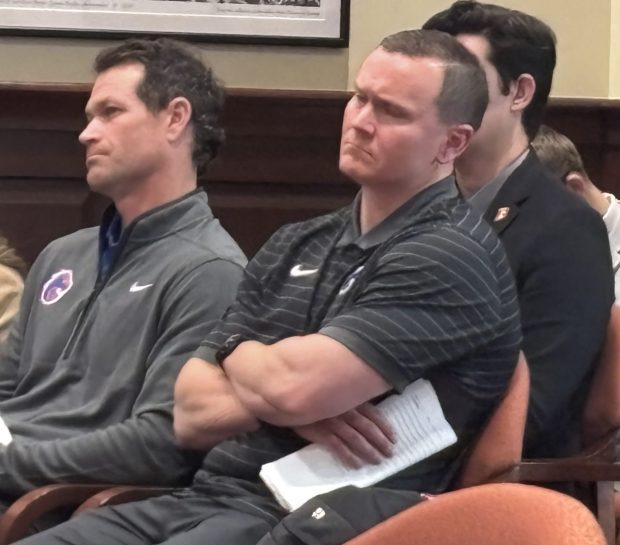
But two Boise State University coaches — football coach Spencer Danielson and women’s tennis coach, Beck Roghaar — said the restrictions would put them at a disadvantage. “This will be used heavily against us,” Roghaar said.
Athletic directors from all three state universities testified against the bill. If the bill were to pass, the University of Idaho would seriously consider dropping both men’s and women’s tennis, athletic director Terry Gawlik. “We would not be able to hold our own competitively.”
Idaho State University athletic director Pauline Thiros said the bill might actually drive Idaho student-athletes to play elsewhere. “The best kids in Idaho … want to go into the best programs. …”
During brief committee debate, Sen. Kevin Cook said the scholarship limits would “wussify” intercollegiate sports by weakening the level of competition. “I think we’ve got to compete with the very best,” said Cook, R-Idaho Falls.
Moment of silence bill heads to Senate floor
After a party-line vote, a bill mandating a 60-second school moment of silence is on its way to the Senate floor.
Tuesday’s debate on House Bill 623 centered on a recurring question: Would a moment of silence open the door to prayer in Idaho public schools?
Critics pointed to language in the bill, which says students can use the 60-second period to “reflect, meditate, pray, or engage in another silent activity.” The bill’s sponsor said the bill would let parents and guardians help their children decide how to use the time.
“This isn’t a sneaky way to get prayer into school,” said Rep. Bruce Skaug, R-Nampa.
Testimony was mixed.
Mendel Lifshitz, a Boise rabbi, said the moment of silence has been tested and proven in nearly three dozen other states — reducing juvenile crime and fostering student mental health. As a result, he said, he believes the moment of silence has reduced teen suicide rates. “It costs nothing, but the benefits are priceless.”
Heather Stout, a Latah County resident, said a “coerced” moment of silence raises First Amendment concerns. “Respect and reflection are best protected when they are voluntary.”
With the Senate Education Committee’s vote, HB 623 now heads to the Senate floor for what could be a final legislative vote. The House has already passed the bill.
House approves career ladder bill recognizing professional experience
The House approved a bill that would recognize professional experience outside the classroom in the state’s salary funding formula — despite opposition from more than two dozen Republicans.
House Bill 849 passed on a 43-25 vote.
Currently, career-technical educators must receive four years of proficient evaluations before they can move up the career ladder, the state’s salary funding model. The bill would allow CTE instructors and professional support staff to move up the ladder with years of experience outside of schools.
“We want to honor the work that they’ve done outside of K-12,” said sponsoring Rep. Soñia Galaviz. “If we can bring them into the K-12 system, fantastic. They get placed a little higher on the career ladder. But right now they are stuck.”
Galaviz, who is sponsoring the bill with Rep. Shawn Dygert, R-Melba, said it would also help districts recruit and retain educators, as neighboring districts and states offer higher salaries.
Before voting against the bill, Rep. Heather Scott, R-Blanchard, asked Galaviz whether she had compared public school salaries to homeschool educators. “They’re not getting paid at all,” she said.
The legislation now goes to the Senate.
Bill creating rules for school polling locations advances
The House State Affairs Committee swiftly passed a bill creating new rules for schools that operate as polling locations.
Public schools’ accessibility and parking make them good polling locations, said Rep. Britt Raybould. But there’s been a “back and forth” in recent years between county clerks and school districts around maintaining student safety during elections.
House Bill 831 would clarify that in-person learning isn’t allowed when a school is used as a polling location. Buildings could still be used for professional development, however, and a district’s other schools could still be open during the election. In addition, students could still participate in an election as volunteers.
“This basically clarifies the language for everyone involved, provides a path forward to ensure that student safety is provided for while, at the same time, ensuring that we have plenty of places for in-person instruction,” said Raybould, R-Rexburg.
Trent Tripple, Ada County Clerk and vice president of the Idaho Association of County Recorders and Clerks, said all 44 county clerks across the state support the proposal. It would help schools maintain safety while providing clerks and voters with predictable polling places, he said. “This is a win, win, win solution.”
After a unanimous committee vote, HB 831 heads to the full House.
Senate passes bill providing more leeway over state facilities funds
The Senate unanimously approved a bill allowing school districts to use state facilities funding on lease-purchase agreements.
House Bill 636 now heads to Gov. Brad Little’s desk.
Under the bill, districts would be allowed to use school district facilities funds — money from House Bill 292 from the 2023 legislative session — on lease-purchase agreements after they pay off bonds and levies.
House quickly passes two education-related bills
Two education-related bills sailed through Tuesday morning House votes.
Money for Anser. House Bill 815 fills a bus transportation loophole affecting Garden City’s Anser Charter School. Anser now receives state transportation money based on what it received, nearly 20 years ago, under a grant for field trips. HB 815 would provide Anser with about $40,000 in new money.
HB 815 passed on a 68-1 vote, with Dalton Gardens GOP Rep. Vito Barbieri casting the lone no vote. It heads to the Senate.
Homeschooler counts. House Bill 846 is designed to ensure that homeschool students are taken off public school attendance rolls. Districts and charters would have to scrub their enrollment lists after the first 10 days of school, removing the names of any no-shows.
The bill passed, 70-0, and goes to the Senate.
Senate passes bill allowing parents to teach driver’s ed
A bill that would allow parents to fulfill driver’s education requirements is heading to the governor’s desk.
Currently, parents in rural school districts can fulfill the state’s requirement that drivers complete six hours of in-car observation and six hours of behind-the-wheel instruction. House Bill 628 would give parents in urban districts the same authority.
The Senate passed the bill on a 29-6 vote Tuesday.
Sen. Ali Rabe, D-Boise, said she opposed the bill because she’s “sensitive to reducing driving education requirements,” noting recent accidents involving pedestrians in the Treasure Valley.

